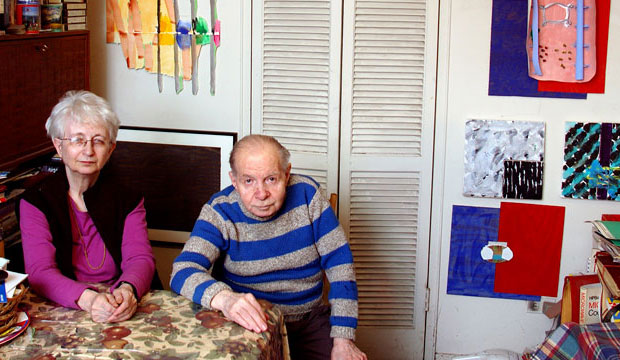
“You don’t have to be a Rockefeller to collect art.” Herbert Vogel, a postal worker, and Dorothy Vogel, a librarian, managed to build one of the most important contemporary art collections in history with very modest means. They lived off of Dorothy’s salary and used Herb’s to collect art. They only had two requirements when purchasing art: the piece had to be affordable, and it had to be small enough to fit in their one-bedroom Manhattan apartment. Their extraordinary story is told in the film Herb & Dorothy, opening in LA and Boston this weekend and currently playing in theatres across the country.
In the early 1960s, when very little attention was paid to Minimalist and Conceptual Art, the Vogels quietly began purchasing the works of unknown artists. Within their self-imposed limitations of the art being apartment-sized and affordable, they proved themselves to be quite the curatorial visionaries. Most of the artists they supported, and subsequently became friends, with went on to become world-renowned artists—Sol LeWitt, Christo and Jeanne-Claude, Richard Tuttle, Chuck Close, Robert Mangold, Sylvia Plimack Mangold, James Siena, Will Barnet, Lynda Benglis, Pat Steir, Robert Barry, Lucio Pozzi, and Lawrence Weiner, (all of whom appear in the film).

Herb & Dorothy Vogel at the Christos’ The Gates in Central Park.
After thirty years of meticulous collecting and buying, Herb and Dorothy had managed to accumulate over 2,000 pieces, filling every corner of their tiny one bedroom apartment. “Not even a toothpick could be squeezed into the apartment,” recalls Dorothy. They did however stash art everywhere seemingly possible—even stacking pieces under the bed… In 1992, the Vogels decided to give their collection a proper home, at the National Gallery of Art in Washington, DC. Many of the works they acquired appreciated so much in value over the years that their collection today is worth millions of dollars. Still, the Vogels never sold a single piece. They still live in the same apartment in New York with 19 turtles, lots of fish, and one cat. Ever as passionate about buying art, they have started refilling it with piles of new art.

The Vogels at the National Gallery of Art in Washington D.C., where most of their collection now lives.
Herb & Dorothy is directed by first time filmmaker Megumi Sasaki and has already received many awards, including the Golden Starfish Award for the Best Documentary Film and Audience Award from the 2008 Hamptons International Film Festival, Audience Awards from the 2008 SILVERDOCS Film Festival and the 2009 Philadelphia Cinefest, and “Best of Fest” at Palm Springs International Film Festival.
Sasaki talks about her vision for the film. “From the beginning, my intention was to make something other than a so-called ‘art film.’ I wanted to capture how these two ordinary people accomplished the extraordinary in the field of art collecting. This film is about the power of passion and love, and a celebration of life.”

The story of Herb and Dorothy Vogel is unique not only because of their avant garde vision and discernment as collectors, but also because of their love and dedication to art. It is through their loving partnership that the viewer truly experiences this remarkable story. The film also sends a message about access, art should not be, nor is it, limited to the elite few. All you need to collect art is good instinct, lots of passion, and a good eye. “Simply take the time to look, look and look.”
In today’s world, where art is treated as another commodity and a work’s investment value takes precedence over its artistic value, Herb and Dorothy offers us an important question: What is it to appreciate and collect art? Sasaki says her fortunate encounter with these beautiful people has truly changed her view of, and appreciation for, art and life. This story will inspire anybody who is trying to survive day-to-day living to pursue their passion, even if it is only as a hobby. You may not have lots of money. Your job may be boring. Life can still be exciting and fulfilling to the extent that we allow ourselves to follow our passions.
You can find out more about the film, including theatres and showtimes, on the website or by joining the Facebook group.