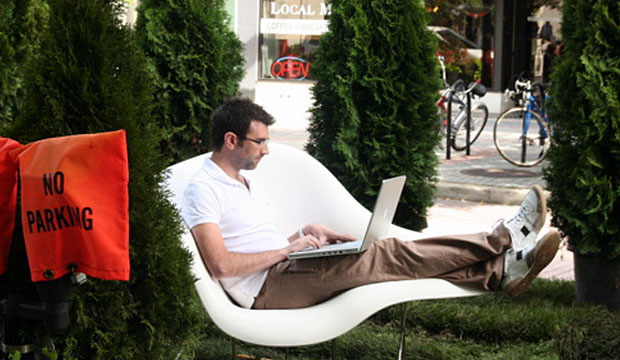
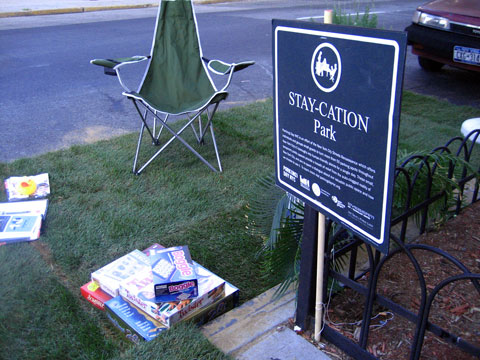
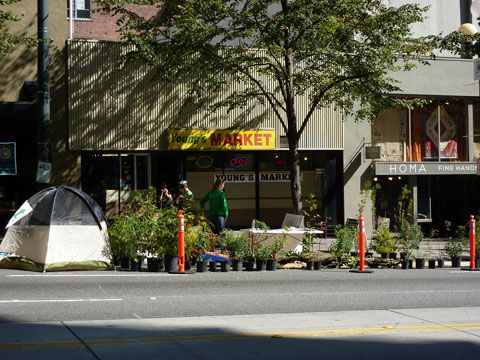
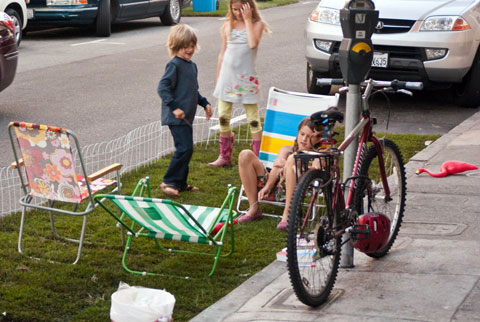
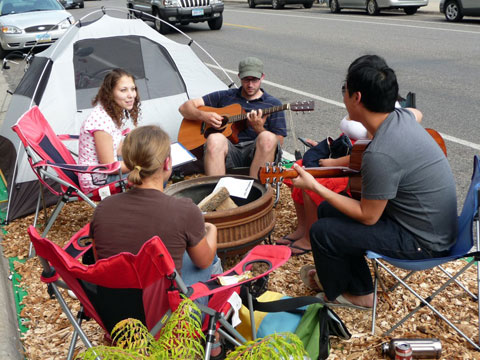
For one day, a few of those rectangular spaces marked in white, usually reserved for clunkers, were temporarily reclaimed for people. On September 18, as part of an annual event called PARK(ing) Day, artists, activists and citizens in cities around the globe helped transform metered parking spaces into public micro-parks, picnic spots and al fresco work spaces.
PARK(ing) Day was originally dreamed up in 2005 by Rebar, a San Francisco art and design studio, in an effort to make people rethink the way streets are used and reinforce the need for broad-based changes to urban infrastructure. “In urban centers around the world, inexpensive curbside parking results in increased traffic, wasted fuel and more pollution,” says Rebar’s Matthew Passmore. “The strategies that generated these conditions are not sustainable, nor do they promote a healthy, vibrant urban human habitat. PARK(ing) Day is about re-imagining the possibilities of the metropolitan landscape.”
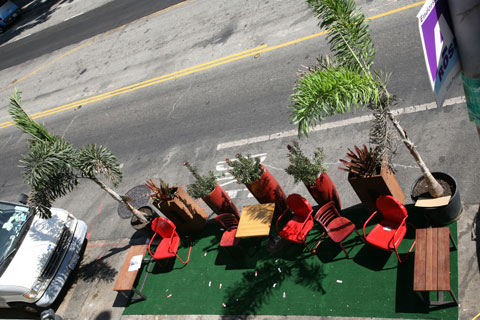
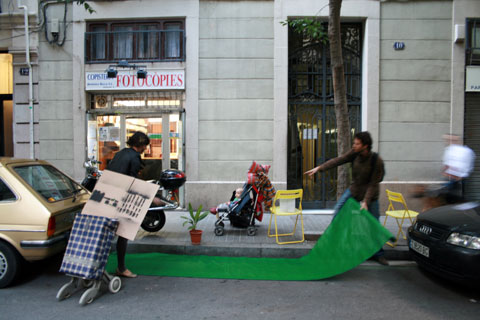
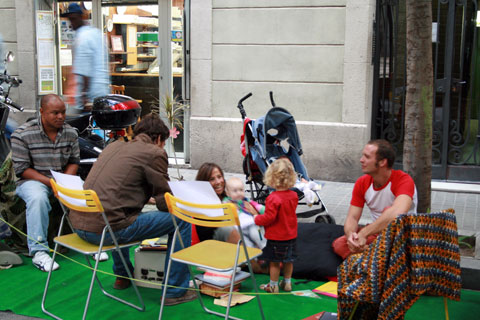
Since 2005, the project has blossomed into a worldwide grassroots movement: PARK(ing) Day 2008 included more than 500 “parks” in more than 100 cities across four continents. This year, the project continued to expand across the globe, with participants in South Africa, Poland, Norway, New Zealand and South Korea. “Urban inhabitants worldwide recognize the need for new approaches to making the urban landscape,” says Rebar’s John Bela. “PARK(ing) Day demonstrates that even temporary or interim spatial reprogramming can improve the character of the city.”
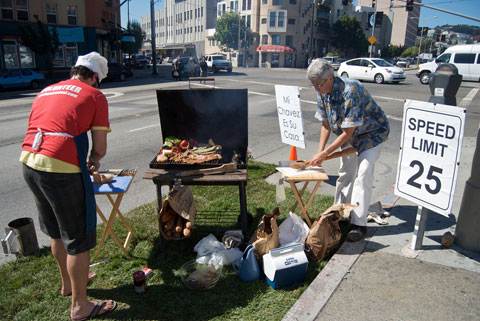
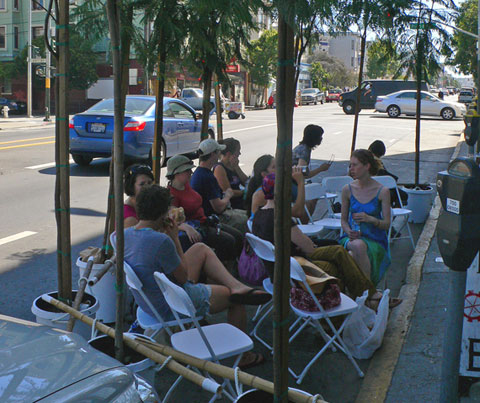
Paul Steely-White, Executive Director of Transportation Alternatives, told NPR’s Brian Lehrer that there were 51 (legitimately permitted) parking spaces turned into parks throughout New York City, not only in traditional metered spots but also in some residential street parking spaces. (Let’s just hope they didn’t have to move the park across the street for street cleaning.) Some had community gardening classes, and in one very special spot on 9th Avenue & 60th Street, Fordham University students put on a “Shakespeare in the Parking Spot” show. Steely-White feels PARK(ing) Day shows us what cities could be, in giving just a bit of space back to the people, we can create vibrant common areas that will enliven neighborhoods.
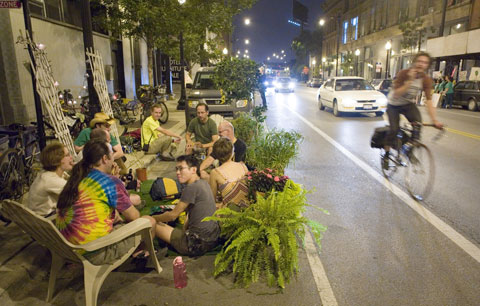
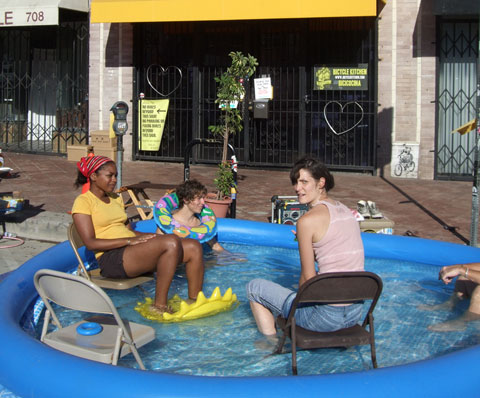
Over the four years of PARK(ing) Day, participants have broadened the scope or “parks” to fulfill a range of unmet social and spatial needs. “From public parks to free health clinics, from art galleries to demonstration gardens, PARK(ing) Day participants have claimed the metered parking space as a rich new territory for creative experimentation, activism, socializing and play,” says Rebar’s Blaine Merker. “While PARK(ing) Day may be temporary,” he adds, “the image of possibility it offers has lasting effects and is shifting the way streets are perceived and utilized.”

PARK(ing) Day is a grassroots, open-source event that depends on the organizational skills of independent groups around the globe, who adapt the project to champion creative, social or political causes that are relevant to their local urban conditions. Rebar has exhibited PARK(ing) Day at venues worldwide, including at the 2008 Venice Architecture Biennale, ISEA 2009 Dublin, the Canadian Center for Architecture, the American Institute of Architects and the Van Alen Institute in New York.
The popularity of PARK(ing) Day is very indicative of how much value we all place on public green space, and how desperately we need more of it. New York’s HighLine Park cannot even compare to the likes of Central Park when it comes to size (it could probably be completely submerged into the reservoir), but as far as impact and popularity goes, the HighLine has brought green space and positive attention back to the Meatpacking District. And people have fallen completely and madly in love with what was just a few years ago nothing but rusty abandoned train tracks. Similarly, the five blocks around Times Square that were closed to traffic this summer, actually brought real New Yorkers back to this tourist trap. The possibilities are endless, people. Tell the people that run your city that you don’t need much, a few square feet of park space is all we need to make a good amount of people happy.
More information regarding local PARK(ing) Day activities and a global map of all participating cities are available on the PARK(ing) Day Network website. Start planning your PARK(ing) space for next year!
Top photo, Herman Miller PARK(ing) Day by stevendepolo, Creative Commons.
For more PARK(ing) Day photos, check out the Flickr group pool.