Fashion and clothing makes waste, there is no doubt about it. Organic clothing is now everywhere, but is that really a good thing? Ultimately, isn’t so-called eco-fashion just creating more waste? Lika Volkova, the designer behind clothing line SANS, thinks so. The creation of a new label, eco or not, means more factories producing, more trucks transporting, and ultimately, more waste being created.
Volkova came to the US from Russia when she was 17. Some years later she started the label ANTILIKA in New York City but found herself questioning the whole spectacle of fashion, where labels rule, fashion shows costs millions of dollars and fashion editors fly across the world to watch a 7-minute runway show they could just as well have viewed online.
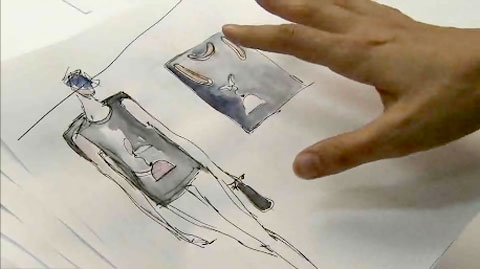
Sketches for the SANS Smile T-shirt.
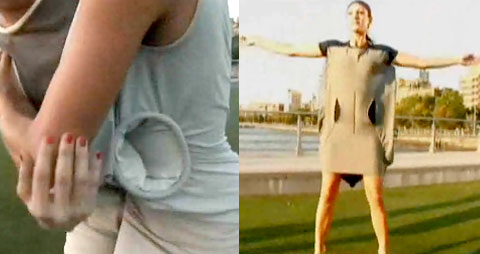
SANS’ clothing is designed to move.
In 2006, Volkova joined forces with Alessandro Devito to form SANS, aiming to produce more eco-friendly clothing with mass appeal. They don’t want to be labeled a “green” or “sustainable” brand, because they feel that kind of thinking just keeps us trapped in the same vicious circle of overproduction. The first collection was created with cutting-edge organic materials like soy fabrics made of tofu by-products. Although she now uses both organic and synthetic fabrics, Volkova is more interested in making pieces that speak to the customer and keeps fashion moving forward, on a steady sustainable path. “Just substituting artificial fabrics with natural ones is not going to be the solution… it’s more important to come up with different values about clothes.”
When they started out “Alex showed me some eco-brands, but they all looked the same,” she says, “there was nothing about them that said it could be a legitimate path to the future.” Her designs are playful, with underlying themes of adaptability and multi-functionality. In her first collection, she modified American basics — jeans were given pockets for drinks, and dresses had two sizes built in to them (perhaps a comment on our fast food/obesity culture).
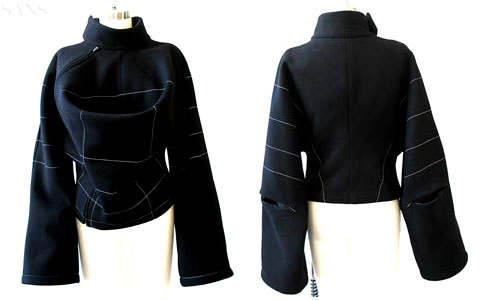
SANS Home Made short jacket ($20).

SANS Home Made long jacket ($20).
In response to their concerns about over-production, SANS devised a bold refreshing strategy. Instead of making pieces of clothing, producing, distributing and selling it, they now sell downloadable patterns on their website. Prices range from $6-$20, which, Volkova says, is no less than what a designer can expect to make on a conventional piece of clothing. The patterns are digital and can be printed out on a conventional printer. For the not-so-crafty, she recommends taking the pattern to a local tailor to have it made. Regardless, the result is a locally-made-to-fit garment that the owner will inevitably be emotionally attached to — and less likely to throw away — after being involved in the entire process of creating it. In Volkova’s words “When you have a piece that you made yourself, you relate to it differently. You value it differently.”
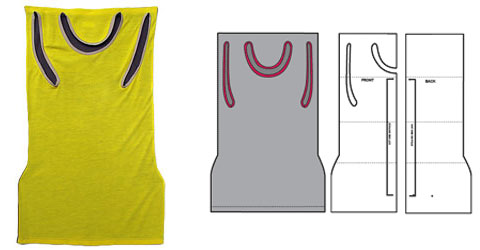
SANS Home Made Smile T-shirt ($6).
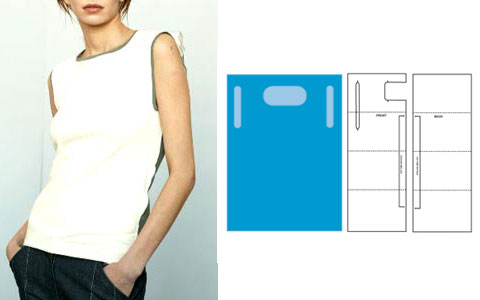
SANS Home Made Square T-shirt ($6).
She concludes by saying she believes the lifestyle will slow down, “and it’s not a bad thing, it’s a good thing.” People are used to being so busy all the time and yet so eager to make things, but instead of trying to make a business out of everything, we should just “do things for yourself, that would be good enough.” Feasible or not, SANS offers a refreshing take on fashion, challenges our notion of what it means to be a consumer, and makes us think twice about our relationship with clothing.
Via SMAC (ScribeMedia Arts and Culture).